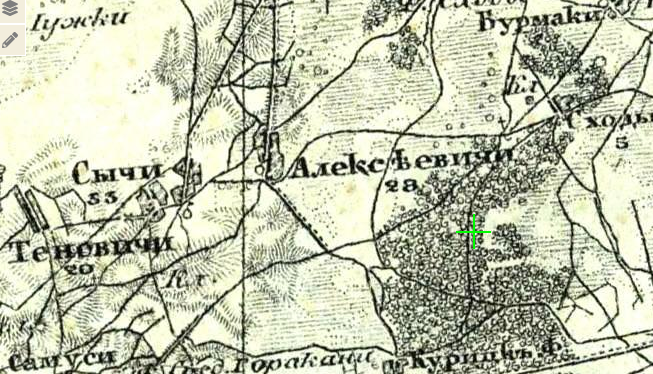
The village Aleksiejewicze was mentioned in 1783 as part of Braszewicze parish. Some of the inhabitants were “Boyars”.
In 1858 it was mentioned as the center of Imienin volost, Kobryn district, Grodno province. There were 262 revision “souls” (state peasants) living in the village. They used to be subjects of the Torokany monastery.
The village of Aleksiejewicze can be seen on the 1860 Schubert's map.
In 1886, the village had 28 courtyards and 377 inhabitants, there was a windmill.
In 1890, the village community (Aleksiejewicze and Baruke) had 686 dessiatinas of land, of which 283 were usable.
In 1905 the village had 580 inhabitants.
After World War I and the Polish-Bolshevik war, starting in 1921, the village was part of the Imienin Commune, Drohiczyn County, Polesie Voivodeship. The village had 38 yards and 244 inhabitants, of whom 235 were Orthodox. There was a functioning school with 50 pupils.

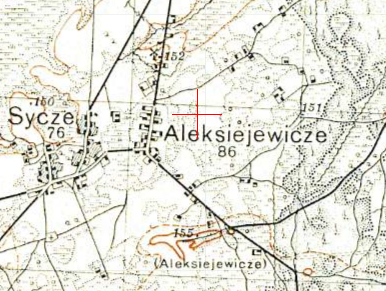
With the advent of Soviet power from 04.12.1939, Aleksiejewicze was listed in Drohichyn district, Pinsk region, BSSR and had 96 courtyards, 615 inhabitants. From 15.01.1940 it was in Drohiczyn district.
Since 1941 the village was under German occupation. According to local residents, the Germans killed the Jews living in the village on the first day. Partisan detachments were active in the area. In the village cemetery in a mass grave were buried partisans of the Suvorov detachment of the Brest partisan unit who died in battles near Aleksiejewicze.
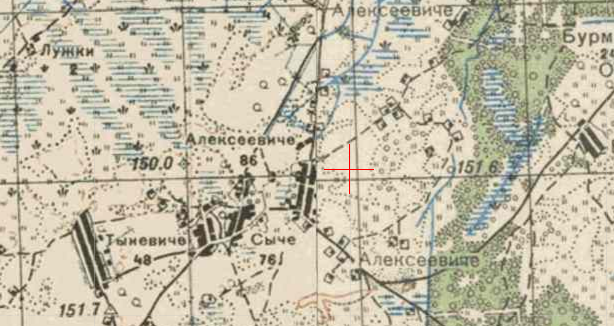
From 12.10.1940 to 16.07.1954 it was the center of the village council of Drohiczyn district. On December 9, 1948, the collective farm “30 Years of the BSSR” was organized in Aleksiejewicze. Later it united with the cooperatives of Dubowiki, Laski, Sycze and Tyniewicze. During the consolidation, the villages Dubowiki and Laski were moved to the central farmstead, and Sycze became part of Aleksiejewicze.
During the Great Patriotic War 35 villagers died, 32 of whom were at the front.
In 1960 the village had 267 inhabitants. In 1969 — 138 yards and 456 inhabitants, it was the center of the collective farm “30 Years of the BSSR”. In 1995 the village had 254 households and 5 inhabitants.
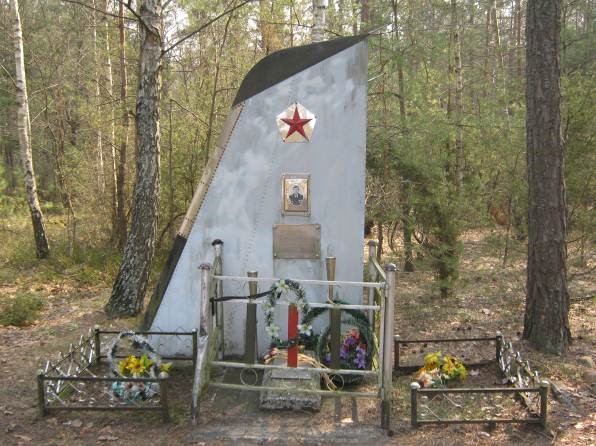
In the village there is a functioning school, kindergarten, obstetric station, communication department, house of culture, a monument to fellow countrymen who died in the Great Patriotic War, and a monument at the place where pilot Nikolai Mikhailovich Glowa took the falling plane away from residential houses on February 12, 1990.