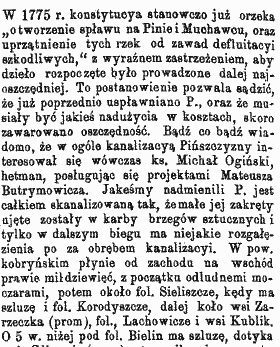
The first mention of the Zarzeczka area dates back to 1620, when it was part of the village of Liachowicze (the village of Liachowicze was first mentioned in 1492). It is possible that the village was also called Derbinka. In the “Geographical Dictionary of the Kingdom of Poland and other Slavic countries, Volume XIV”, the description of the canal mentions the village Zarechka in 1775:
In 1778 it was a part of Drohiczyn county. It became an independent village in 1783, when the Dnieper-Bug (Royal) Canal was completed. The village belonged administratively to the Brest Voivodeship of the Grand Duchy of Lithuania. Orthodox Christianity was finally established only at the end of the 15th century. Before that, paganism had a huge weight. To this day, some of the Christian holidays are called by pagan names.
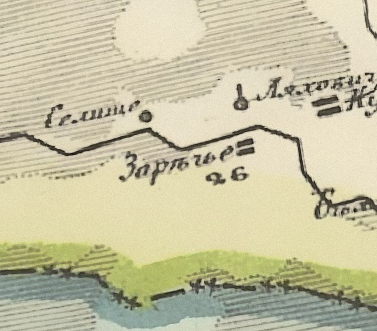
From 1795 it was a part of the Russian Empire, in Kobryn district, Slonim district, from 1797 Lithuanian, from 1801 Grodno province. On Schubert's map for 1826-1840 our village is also marked:
Also the village is marked on the military topographical map of the Russian Empire in 1843-1864:
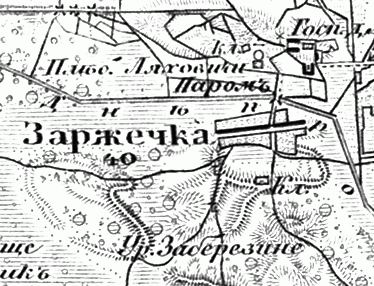
In 1858 it was a village in Osowiec province, the center of the village community, part of the Liachowicze estate, owned by the landowner Georgy Szemet. There were 321 revision souls (state villagers). In 1886 the village had 40 courtyards and 547 inhabitants; there was a drinking house. In 1905 the village had 764 inhabitants.
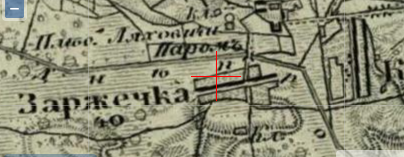
The village is on the one-verst map:
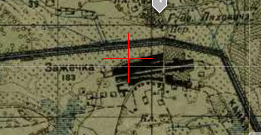
Also on the three-verst map:
In the archive RGIA, F. 577 Op. 10 Д. 901 there is a mention of our village, extreme dates June 7, 1865 – August 22, 1872:
Deal on the redemption of temporarily burdened peasants' land from Winter M.V. estate Seliszcze or Zarzeczka. (Grodno province).
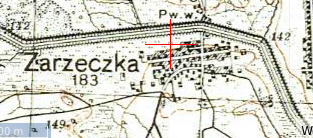
From 1921 till 1939 in Poland, in Osowiec commune, Drohiczyn district, Polesie voivodeship. In 1921 there were 175 households and 867 inhabitants, of whom 842 were Orthodox. The village is on the Polish WIG map:
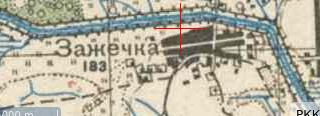
From 1939 it was part of the BSSR; there were 224 households and 900 inhabitants. From 12 October 1940 in Popina village council, Drohiczyn district, Pinsk region. Since 1954 in Brest region. During the Great Patriotic War in February–March 1944, partisans of the Molotov Brigade and Pinsk partisan associations fought in the region of the village. The 42-day defense of the Dnieper-Bug Canal by partisans against German attacks in February–March 1944 is known. As a result, almost all houses and buildings were destroyed, and the local population was evacuated to the area of the Pripyat River to the villages of Mukoszyn and Lubotyn (Ukraine). 29 inhabitants of the village were killed in partisan resistance and died at the front. The village on the Red Army map:
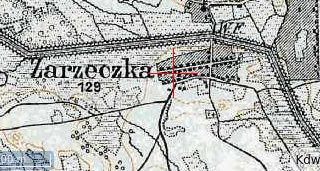
Also on the German map kdwr:
In 1959 the village and the farm had 1268 inhabitants. In 1951–1958 it was the center of the village farm named after "Andreev". In 1958–1964 it was the center of the farm “Zarya”. In 1970 the village was the center of the collective farm “Druzhba”, with 1159 inhabitants. In 1995 there were 290 yards and 916 inhabitants.
On September 25, 2010, in the village of Zarzeczka, an Orthodox church-chapel was consecrated in honor of the locally venerated icon of the Kazan Mother of God. The reason for the construction was an event from 1936, when in an ordinary rural family living in Zarzeczka, the mistress of the house began to observe that the old family icon of Our Lady of Kazan surprisingly brightened and began to be renewed. The icon began to emit a quiet bell ringing, which was heard for two months. A commission from the then Pinsk Monastery witnessed this miraculous phenomenon.